Emergency Vet Cost: What You'll Really Pay, and How to Afford It
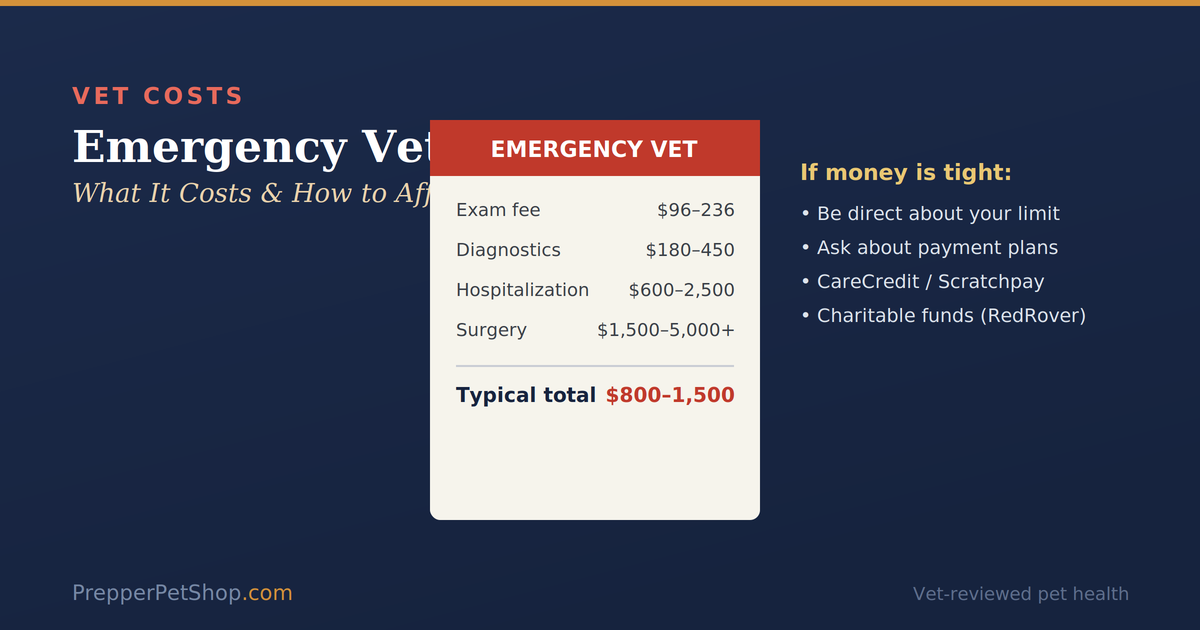
Nobody wants to think about the price when their pet is in crisis, but knowing the real numbers ahead of time helps you act fast and make good decisions under pressure. This guide gives honest 2026 ranges, shows what an itemized bill is made of, and: most importantly. Walks through concrete ways to get care when the cost feels impossible.
Real 2026 emergency vet cost ranges
| Situation | Typical cost |
|---|---|
| Emergency exam / triage fee | ~$100–$235 |
| Diagnostics (bloodwork, imaging) | ~$180–$450+ |
| Moderate emergency (exam + basics + treatment) | ~$800–$1,500 |
| Hospitalization | ~$600–$2,500 |
| Emergency surgery | ~$1,500–$5,000+ |
| Serious cases (bloat, blockage, trauma, poisoning) | ~$1,000–$8,000 |
Ranges from 2026 veterinary cost data (Spot, CareCredit, Webvet, Petful). Actual cost depends on your region, the specific emergency, and your pet.14
For context on specific incidents: toxic ingestion claims averaged around $700, and a bite-wound visit averaged about $600 in recent insurance data.1 If your dog got into something, see dog ate chocolate.
Why it costs so much
Emergency hospitals run 24/7, vets, technicians, and support staffed through nights, weekends, and holidays at premium pay, and keep advanced diagnostic and surgical equipment ready at all times.5 Those fixed costs, plus the critical nature of the cases, make an ER visit 2–4× a routine appointment. Location matters too: urban and coastal clinics charge more than rural or Midwestern ones.5
The deposit reality
If money is tight right now
Work the options in order of speed. And start by being honest:
- Tell the team your limit, plainly. Emergency staff have this conversation daily and can build a plan around real numbers, including essential stabilization within a budget, but only if you're upfront.2
- Apply for financing at the desk. CareCredit or Scratchpay approvals take minutes and can cover the deposit.2
- Ask about a payment plan. Many clinics will split a large bill for established clients.2
- Transfer once stable. Moving continued care from the ER to your daytime vet can cut hospitalization costs substantially.2
- Contact charitable funds. RedRover Relief, breed rescues, and others offer emergency grants, see our vet bill assistance guide.2
The insurance math
With a typical accident-and-illness policy, you pay upfront and get most of it back: on a $2,000 emergency with a $250 deductible and 80% coinsurance, your net cost is about $600 rather than $2,000.3 Coverage depends on your deductible, coinsurance, waiting periods, and exclusions — and pre-existing conditions generally aren't covered, which is why enrolling before problems arise matters.
ER vs. urgent care vs. your regular vet
Not every after-hours worry is a true emergency, and matching the venue to the situation saves real money. A 24/7 emergency hospital is for life-threatening problems — trouble breathing, collapse, suspected poisoning, bloat, trauma, uncontrolled bleeding, or a male cat straining to urinate. A growing number of urgent-care vet clinics handle the in-between cases (a wound that needs stitches, a limping dog, vomiting that isn't severe) at lower cost than an ER, often with evening and weekend hours. And for anything that can safely wait until morning, your regular daytime vet is almost always the cheapest option. When you're unsure how urgent it is, many pet insurers and services offer a 24/7 vet triage line that can tell you whether to go now or wait — a free call that can save both an unnecessary ER bill and a dangerous delay.
How to prepare before an emergency
- Build an emergency fund — experts suggest $1,000–$2,000 set aside for pet emergencies.1
- Consider pet insurance while your pet is healthy, before conditions become pre-existing.
- Set up a credit option (CareCredit) in advance so it's ready.
- Save the numbers — your vet and a 24/7 ER — in your phone now.
Frequently asked questions
How much does an emergency vet visit cost?
Usually $800–$1,500 for moderate cases; $1,000–$8,000+ for serious ones with imaging/surgery/hospitalization. Exam alone ~$100–$235. ER visits cost 2–4× a regular vet.
Why is it so expensive?
24/7 staffing at premium pay plus advanced equipment ready at all times, and the critical nature of cases. Urban/coastal areas cost more.
Do they make you pay upfront?
Usually a deposit (often 50–100% of the estimate) before treatment. Financing at the desk can cover it; be upfront about your budget.
What's in the bill?
Exam/triage, diagnostics, treatment/meds, and for serious cases hospitalization and surgery. Ask for an itemized estimate to prioritize.
What if I can't afford it?
Tell the team your limit, apply for CareCredit/Scratchpay, ask for a payment plan, transfer to your regular vet once stable, and contact funds like RedRover Relief.
Does insurance cover emergencies?
Most accident-and-illness policies do after the deductible (70–90% reimbursed). You pay upfront and get most back. Pre-existing conditions generally excluded.
Cheaper at my regular vet?
For a true emergency, go where treatment is fastest; once stable, transfer to your daytime vet to cut costs. Non-urgent daytime issues: regular vet or urgent care.
How we reviewed this article
This guide synthesizes 2026 US emergency cost data from pet-insurance and veterinary cost sources, presented as ranges, not quotes. It's written to help you act under pressure and, above all, to make clear that cost rarely has to mean choosing between your money and your pet — there are real options. Every figure is numbered to a source below. This article was medically reviewed by Dr. Marc Dhumeaux (DVM, Dip. ACVIM & ECVIM-CA (Small Animal Internal Medicine)) on September 14, 2026. The reviewer verified the clinical accuracy of the guidance; PrepperPetShop is responsible for the final published text.
Sources & references
- Spot Pet Insurance. Emergency Vet Visit Costs 2026. $800–$1,500 typical, exam/diagnostic/hospitalization/surgery ranges, toxic-ingestion/bite averages, $1,000–$2,000 emergency fund. spotpet.com
- Petful. Emergency Vet Cost 2026: What You Will Really Pay. Deposits, being direct about limits, payment plans, transfer-when-stable, RedRover, credit-vs-cost caveat, insurance math. petful.com
- Petful / insurance math. Example: $2,000 emergency, $250 deductible, 80% coinsurance → ~$600 net. petful.com
- Webvet. Emergency Vet Cost in 2026: Prices by Emergency. Serious emergencies $1,000–$8,000; upfront deposit norms; financing/charity options. webvet.com
- Petnicki. Emergency Vet Cost USA 2026. Why ER costs 2–4× regular care (24/7 staffing, equipment); location effect; assistance options. petnicki.com
Sources current as of September 2026. Educational content, not financial or veterinary advice. Confirm costs with clinics; prices vary by region and case.